.svg)
Music Makes You Creative
Music develops the cognitive capacity to turn imagination into original ideas.
- Guhn, Emerson and Gouzouasis, Journal of Educational Psychology
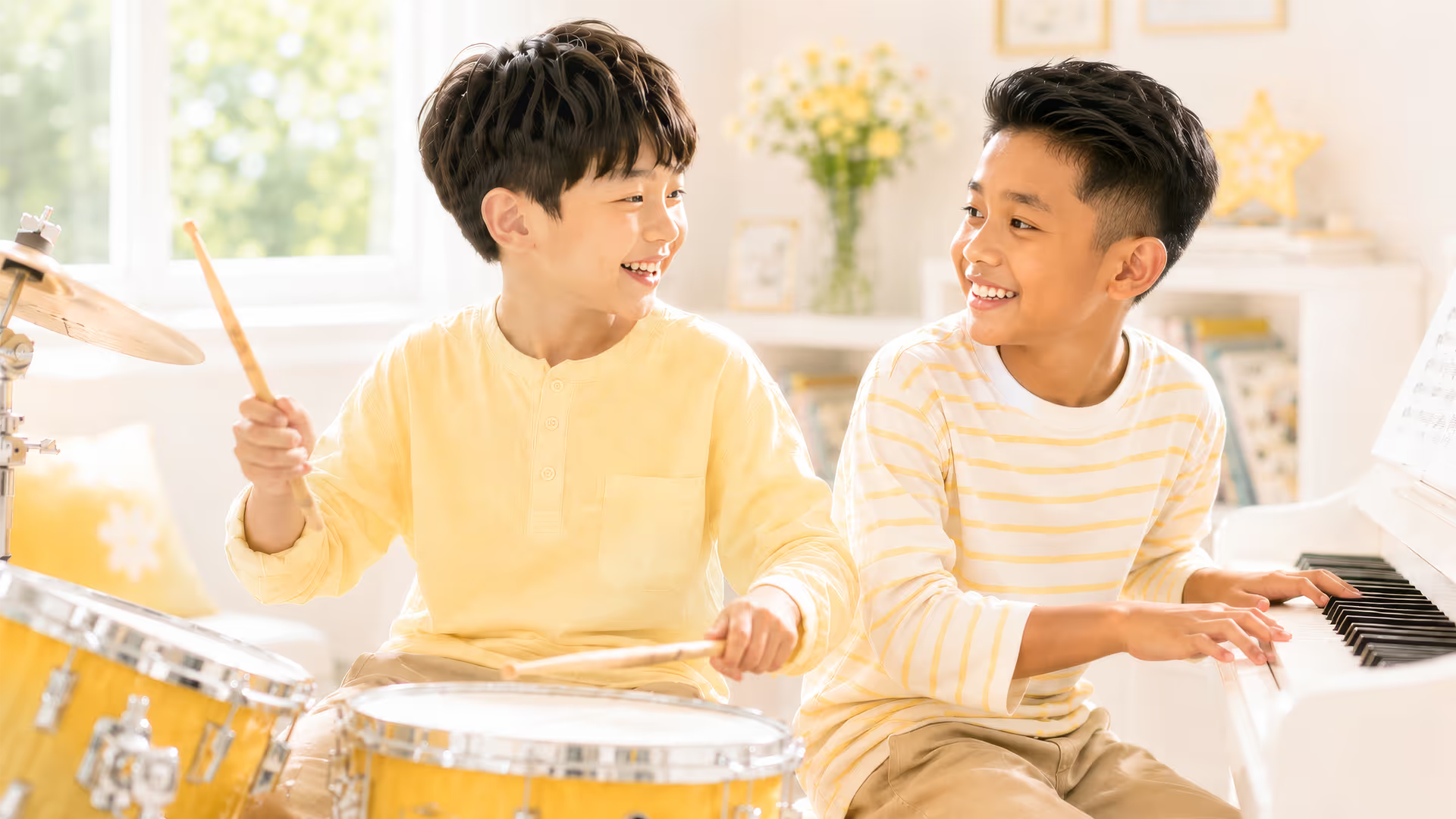
Encourages Imaginative Exploration
Learning music opens up new ways of thinking in the studio, in the classroom, and in everyday life.
Creativity is not a fixed trait. It is a skill that can be built, practised, and strengthened over time. Music is one of the most powerful environments for doing exactly that. When students learn to play, compose, or improvise, they engage parts of the brain responsible for generating ideas, making connections, and thinking in open-ended ways. Research consistently links musical training to enhanced creative thinking, not just in music, but across domains. For children, this means developing a mind that asks "what if?" rather than "what's right?" For adults, it means keeping that same curiosity alive.


Unlocks Divergent Thinking
Music trains the mind to explore multiple possibilities, not just find the one correct answer.
Divergent thinking is the ability to generate many different ideas from a single starting point. It is at the heart of creative breakthroughs in art, science, design, and business. Research on formal musical training has found that musicians consistently score higher on divergent thinking tasks than non-musicians, and that the more extensive the musical education, the stronger this effect becomes. The reason is structural: music asks students to interpret, adapt, and invent constantly. There is rarely one way to phrase a passage, one way to solve a rhythmic problem, or one way to bring a piece to life. That openness trains the brain to stay flexible.
Builds Expressive Confidence
Music gives students a language for ideas and emotions that words alone cannot always capture.
One of the most meaningful things music does for creativity is give people permission to express what they feel and imagine. For children, this is foundational, learning to communicate through sound develops emotional intelligence alongside creative confidence. For adults, music can reconnect them with a creative part of themselves that often gets set aside. Studies have found that active engagement in music education supports not only creative expression but also improved confidence, better mental health and emotional stability. When students trust that their musical voice matters, that trust carries over into how they approach creative challenges everywhere else.


Develops Creative Problem-Solving
Music teaches students to approach challenges with curiosity and experiment their way to solutions.
Every music lesson contains creative problems to solve: how to navigate a difficult passage, how to interpret a composer's intent, how to make a piece feel alive rather than mechanical. Research in music education has found that allowing students to produce solutions to musical challenges improves their critical and creative thinking skills and that students who engage in musical improvisation show significant gains in creative originality and flexibility. These are not just musical skills. The habit of experimenting, adjusting, and trying again is exactly what creative problem-solving looks like in every field.
Related Articles
The impact of musical improvisation on children’s creative thinking
Every music lesson is a creative problem to solve. Students who improvise and interpret show gains in originality and flexibility, habits that transfer to every field.

Researchers find music education benefits youth wellbeing
Music gives people permission to express what they feel. For children, this builds creative confidence. For adults, it reconnects a part of themselves often set aside.
Formal musical training appears to strengthen the link between working memory and creativity
Musicians consistently outscore non-musicians on divergent thinking. Music trains this naturally, there is never just one way to phrase, solve, or bring a piece to life.
Enhanced divergent thinking and creativity in musicians: A behavioral and near-infrared spectroscopy study
Music builds creativity as a skill, not a trait. Playing, composing, and improvising train the brain to connect ideas and ask "what if?"
From Our Families
Hear it straight from our parents and students!